


☕ Welcome to The Coder Cafe! Today, we explore the wisdom of crowds: why groups of strangers can outperform the world’s best experts, when that power breaks down, and what it means for the organizations we work in. Get cozy, grab a coffee, and let’s begin!
A few weeks ago, I was scrolling on X when I stumbled across that poll:

I picked an option (the red) and looked at the results:
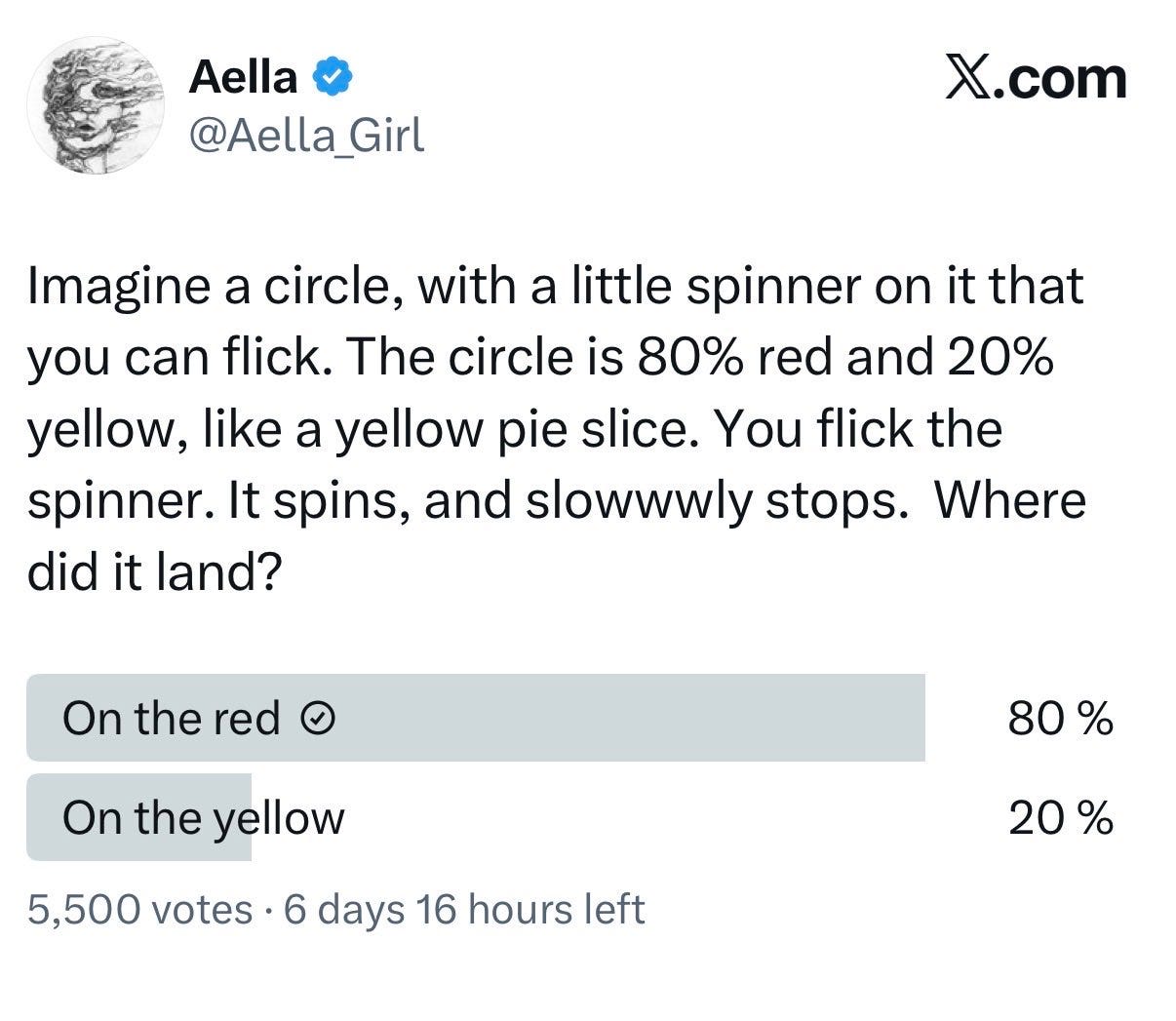
Quite surprising, right? Thousands of people voted, and the result landed exactly on the theoretical proportions of the circle. Each person made an independent judgment, and together they converged on the truth.
It reminded me of a story I read in a book about crowds (see the Sources section at the end).
The Ox Experiment
In 1906, Francis Galton attended a livestock fair in Plymouth. He was a statistician and a firm believer that most people were too ignorant to be trusted with important judgments. At the fair, a competition was being held: guess the weight of an ox. Around 800 villagers took a shot at it.

Galton collected all the guesses, expecting to confirm his thesis. The average came out to 1,197 pounds. The actual weight of the ox was 1,198 pounds. Off by a single pound, representing an error margin of less than 0.1%.
He had set out to prove crowds were unreliable. He ended up proving the opposite. This phenomenon has a name: the wisdom of crowds. The idea is that under the right conditions, the average of many independent judgments tends to be more accurate than any individual guess, including experts.
But estimating the weight of an ox is one thing. What about something far more complex, like competing against one of the greatest chess players of all time?
Kasparov vs. the World
In 1999, chess grandmaster Garry Kasparov played a game unlike any other. The game is called “Kasparov vs. the World.” On one side: Kasparov, widely considered the best chess player alive at the time. On the other: the entire Internet.
More than 50,000 people from 75 countries voted on each move for the black pieces. The game ran for four months on an online gaming platform.
At move 36, the crowd faced a critical decision. The position had seven pieces left on the board, and in 1999, no chess engine could reliably evaluate endgames of that complexity. The computers were useless. Even the experts weren’t sure.
The crowd voted for Kd5.
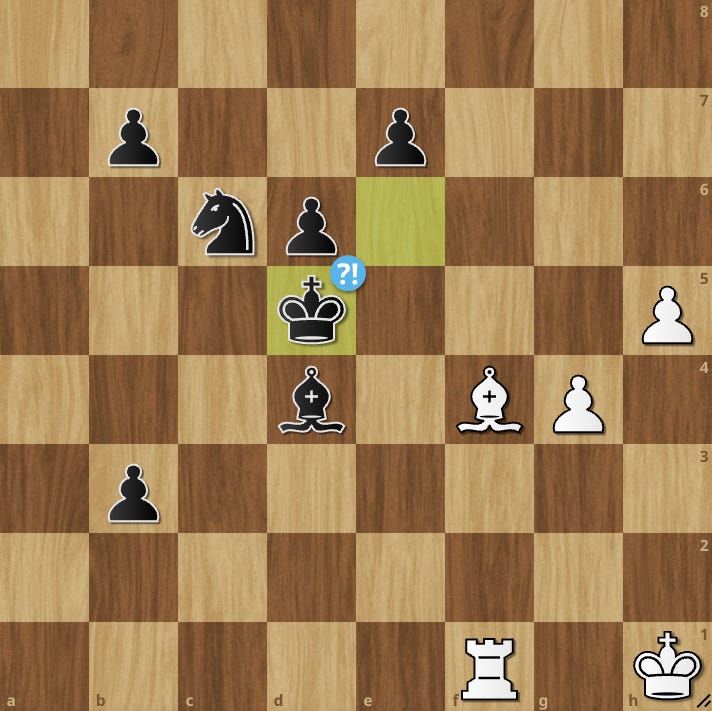
Years later, once seven-piece endgame tablebases were finally built, analysts confirmed it: Kd5 was the only move that kept the draw alive. Every other candidate lost. Fifty thousand amateurs, voting in real time, had found the answer that computers couldn’t verify until years later.
Kasparov ended up winning that game, but he said he had never worked harder on any game in his career. He later called it “the greatest game in the history of chess,” because of the quality of the game itself. He wasn’t playing against a few strong opponents. He was playing against collective intelligence.
When It Works and When It Doesn’t
The wisdom of crowds is not magic, and it doesn’t always work. The reason it works is that a specific set of conditions must be met:
Independence: Each person must form their opinion without being influenced by others. The moment people start copying each other, herding takes over, and the crowd loses its accuracy.
Diversity: The crowd needs to include people with diverse backgrounds, knowledge, and perspectives. A crowd of identical experts is not a crowd; it is a committee, and committees tend to amplify shared biases rather than cancel them out.
Decentralization: People should be drawing on their own local knowledge and experience, not a single shared source. The villagers at the livestock fair each had different ways of estimating the ox’s weight. That variety is what made the average so accurate.
Remove any of these three conditions, and the result degrades quickly. A crowd of people all watching the same news anchor before voting is not independent. A panel of experts from the same field is not diverse. A group relying on the same report is not decentralized.
The X poll worked for exactly those reasons: strangers voting independently, with no results visible before submitting, from all walks of life.
Crowds Inside Organizations
Now, the 1 million dollar question: If the wisdom of crowds can be so powerful, can companies harness it deliberately?
In 2015, economists Bo Cowgill and Eric Zitzewitz published a study on internal prediction markets across several companies, including Ford. At Ford, employees were asked to predict which car features customers would actually want, a question that directly influenced where engineering investment went. The result: the crowd reduced the error of the official expert forecasts by up to 25%. That is not a small number. A quarter less error, on decisions worth millions of dollars.
But here’s where it gets interesting. The same research that makes the case for collective intelligence also reveals its limits.
IBM ran what it called an Innovation Jam in 2006, a 72-hour online event that drew 150,000 participants from 104 countries. Employees, customers, researchers. They generated 46,000 ideas. Ten new business units were funded with $100 million. The seeds of IBM’s Smarter Planet strategy came out of it.
Sounds like a triumph. And in some ways it was. But here’s what the post-mortem revealed: senior leaders had to spend weeks sifting through “gigabytes of often aimless conversation” to extract anything usable. The crowd produced raw material. Humans still had to synthesize it into a strategy.
And then there’s the cautionary tale. Valve, a video game company, famously has no managers. Employees choose what to work on. The idea sounds like the wisdom of crowds taken to its logical conclusion. In practice, it produced one extraordinary success, the Steam platform, and a long tail of abandoned projects, canceled hardware lines, and years without a major game shipped.
Three companies, three different outcomes. Ford met the conditions and made better decisions. IBM met them partially and got raw material. Valve never met them at all and drifted.
Putting the Wisdom of Crowds to Work
So, how should companies actually use the wisdom of crowds principles?
The temptation could be to treat collective intelligence as a management philosophy: flatten the hierarchy, let everyone vote, trust the crowd. Valve tried something close to that and ended up with one extraordinary platform and a graveyard of abandoned projects. The crowd wasn’t wrong. There was just no one filtering it.
The companies that get real value from crowds treat them as a tool, not a strategy. They ask narrow, answerable questions and let the crowd inform the decision, not make it. The crowd produces signals. Leaders have to extract it.
Before asking a crowd anything inside an organization, check the three conditions:
Are people forming opinions independently, or is everyone influenced by the same all-hands deck?
Is the group genuinely diverse, or is it five people from the same team who already agree?
Is everyone drawing on their own knowledge, or are they all citing the same internal report?
If the three conditions hold, the crowd may even outperform the experts. If they don’t, the result is just noise.
Remember. Crowds are a tool. A sharp one, when used for the right cut. The hard part is recognizing when the conditions are actually met.

Summary
The wisdom of crowds is real: under the right conditions, the average of many independent judgments consistently outperforms individual experts, including the best ones.
The three conditions are non-negotiable: independence, diversity, and decentralization. Remove any one of them and the crowd produces noise, not insight.
The phenomenon scales beyond simple estimation. Fifty thousand amateurs found the only drawing move in a position that stumped chess engines.
Companies can harness it deliberately. Ford used employee prediction markets to cut expert forecasting error by 25% on real product decisions.
But collective intelligence is a signal-generating machine, not a decision-making machine. IBM got 46,000 ideas from 150,000 people and still needed weeks of human synthesis to turn them into a strategy.
Full autonomy is not the wisdom of crowds. Valve gave employees complete freedom and got drift. The conditions were never met to begin with.
Resources
More From the Beyond the Code Category
Sources
Fouloscopie // The book I’m mentioning in the post. Unfortunately, it’s only in French.
Corporate Prediction Markets: Evidence from Google, Ford, and Firm X Get access Arrow
Galton was trying to show median was superior to mean (but the weight guessing contest showed the opposite). He'd been studying civil jury awards and believed they should be decided by the median amount because that way a single juror couldn't skew the number.
Galton was trying to prove median was superior to mean (but mean was closer to the truth in the weight guessing contest). He's been researching civil jury awards and thought median superior because a single juror couldn't skew the amount.